Wool House: The Best Bits

Phew, what a week! The world’s first ever Wool House showcase and the world’s biggest ever celebration of Wool has now reached it’s conclusion. With 10 days of interior design, fashion, craftsmanship and textile excitement, there is certainly a lot to reflect on. We thought we would do a round up of some of the amazing events that have taken place over the course of this fantastic festival of all things wool.

Launch Party

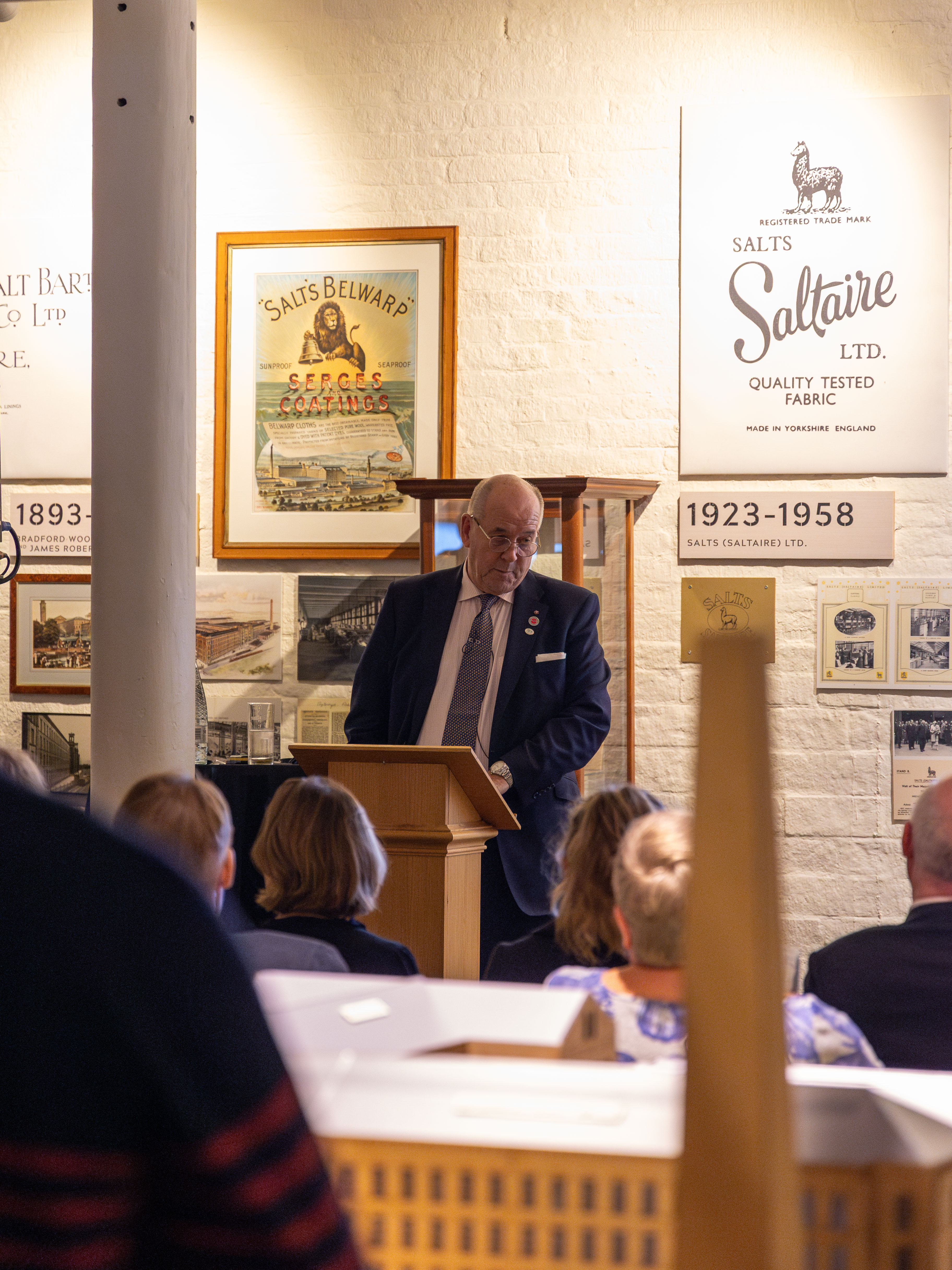
Way back on the evening of the 12th of March, the Wool House celebrations were put into motion, with a Launch Party headed by Campaign for Wool chairman John Thorley.


“This remarkable Wool House event is a culmination of an ambition which was set out by our patron his Royal Highness, The Prince of Wales to showcase and highlight the natural, renewable and wonderfully sustainable fibre which comes off the sheep’s back”
- John Thorley, CfW Chairman
Click here to see more pictures from this event


Sheep In Wool House

The historic institution of Somerset House had some very special guests of honour at the start of Wool House.  The central courtyard was home to some very special woolly characters for a few days.  After all, without these cheeky sheep, none of this would have been possible!


Our ruminant friends adjust to the grandeur of their new surroundings
Click here to see more pictures from this event

Crochet Club

Of course, even with all the showcases and exhibits on display for the duration, who could overlook some of the demonstrations, workshops and classes that have taken place in the craft room, including the fantastic Crochet Club?  Hosted by Rowan Yarns in conjunction with Country Homes & Interiors, held throughout the week, the crochet club helped a number of guests of all skill levels to advance their crochet technique.


Some Wool House guests getting to grips with the art of crochet.
Click here to see more pictures from this event

Jason Collingwood in Working Residence

Rug-making maestro and wool-weaving extraordinaire, Mr Jason Collingwood took up a working residence for the duration of the event, dutifully demonstrating his craft for the benefit of the lucky guests.


Mr Rug
himself demonstrating how all the rugs are made!

The Savile Row Tailor Room

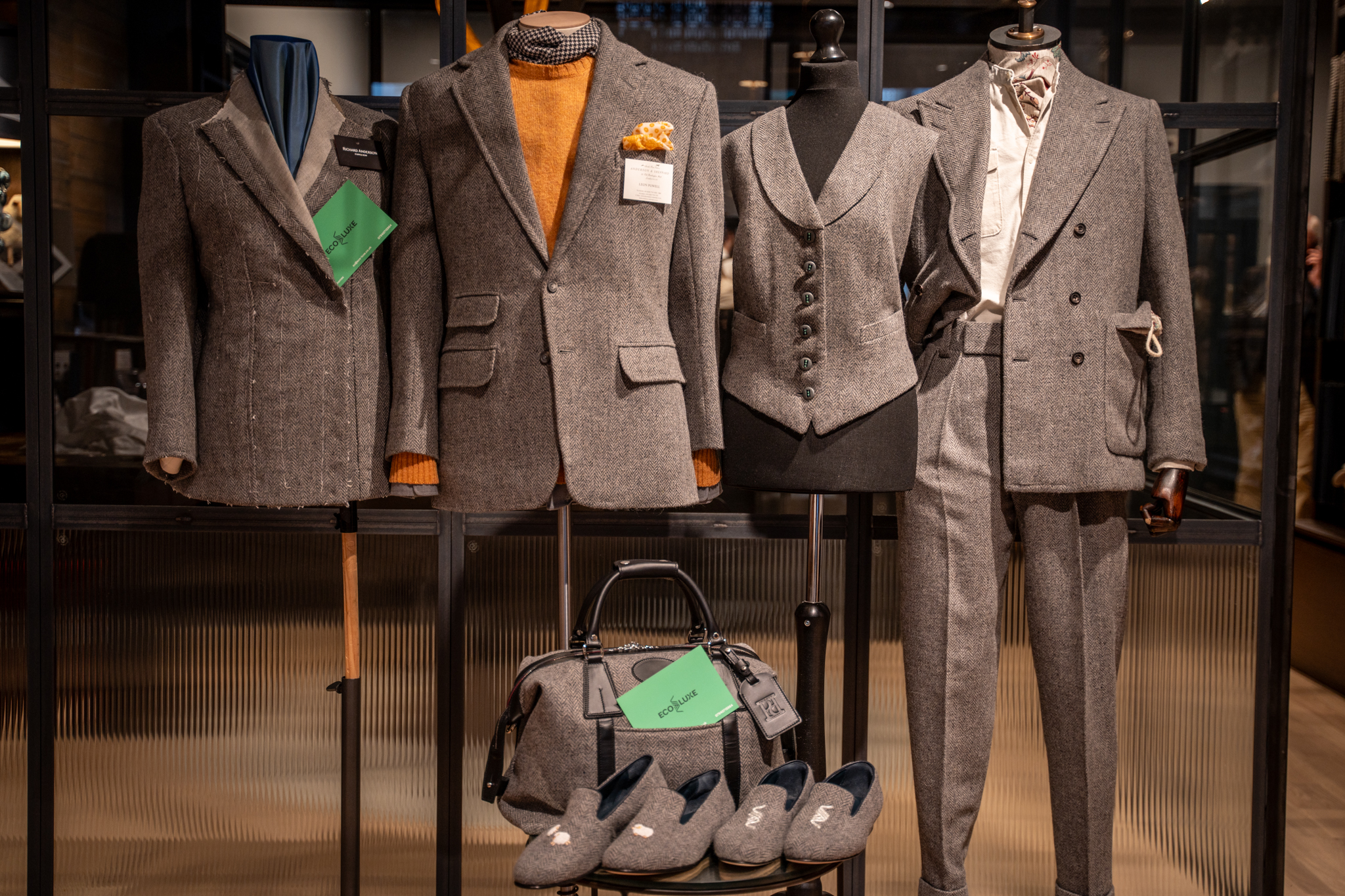
The Savile Row Bespoke Association’s room at Wool House saw guests marvel in awe at the impeccable style on display.  The highlight was undoubtedly the “Wool in Fashion” showcase, which saw Henry Poole & Co team up with the Savile Row Company to give a masterclass demonstration of their craft.


A triumph of fashion and style – the Savile Row room
Click here to see more pictures from this event

Tom Says “Darn It”

The wonderful Tom of Holland was also present at Wool House running a number of drop-in darning sessions to share his wisdom with the Wool House guests


Tom shares his techniques with some guests
Click here to see more pictures from this event

Mattress Making with Vi-Spring

An incredibly fascinating demonstration, Vi-Spring wowed the Wool House crowd by showing exactly how their luxurious, all-wool mattresses are put together.


Master craftsman Danny Harris is showing to the Wool House crowd how the all-wool Devonshire mattress is made, including the genuine hand side-stitching.

Tweed Tea Party

The Wonderful Tweed Tea Party was nothing more than an excuse to dress up in tweed, have a drink and bask in the versatility of Wool.  And a good excuse at that!


Tweed galore!
Click here to see more pictures from this event

HRH Prince Charles Pays A Visit

Who could forget the closing event of Wool House, a visit from Campaign for Wool Patron, HRH Prince Charles?  The Prince toured the many sights and showcases inhabiting Somerset House before delivering a closing speech.


HRH Prince Charles makes himself at home in Ashley Hicks’ study
Click here to see more pictures from this event

Of course, there was far more to Wool House than it was possible to fit in this round up.  Check out our Facebook page and our Twitter feed for more information about Wool House!

Wool House: Meet The Designers

As part of the action packed schedule for our 10 day Wool House showcase, Tuesday the 19th saw Bridgette Kelly of the British Wool Marketing Board and Giles Kime from Homes & Gardens hold a “Meet the Designers” event with Wool House designers Kit Kemp, Josephine Ryan, Ashley Hicks, Mary Fox-Linton and Wool House curator, Arabella McNie.  There were limited seats at the event, which quickly filled up, so we’re thrilled to be able to bring you some insights from this introspective and enlightening Q&A session. See the full transcript from the session below.

Bridgette Kelly:
“Welcome to Wool House. Wool House was an idea that was born out of a moment of madness where you think: “How are you going to persuade people to choose wool?”

Bridgette Kelly delivering her introductory speech.

“”I work for the Campaign for Wool and my job is to roll out ideas that are going to make people embrace this special fibre.   I am indebted in this project to a very huge group of people.  I am indebted to the textile industry and its designers who have been marvellous at embracing what has been quite a difficult brief at times. ”

“For interiors, we wanted to showcase wool as a lifestyle fibre, making it look as beautiful as it possibly could be, and as practical as any fibre in the world.  ”

“The textile industry is very diverse, as you have seen when wandering around this space.  It is fashion.  It is interiors.  It is bedding and beds.  It is crafting.  It is wonderful suits and all sorts of other things. In this house we have managed to show people how fantastic it can look and be.  Mostly, the beauty of that is about how somebody takes that space and makes it look.  I was very lucky in finding Arabella McNie as my curator/stylist.  She has been a marvel to work with.  Arabella has had a horrible timeline in which to produce it and I have to say she didn’t have a very big budget either, so I have to say she has produced a really special event for all of us to enjoy. ”

“Tonight we welcome our designers and I also have the great privilege of introducing Giles Kime from Homes&Gardens.”

Giles Kime kicks off the Q&A.

Giles Kime:
“Thank you everybody for coming this evening. I think the fact that this room is filled to the gunnels is a reflection not just of the amazing project that Bridgette and Arabella have put together.  We are also amazingly fortunate to have four of Britain’s leading designers with us tonight, who are going to talk us through the schemes that you’ve just been looking at.”

“I first saw Wool House exactly a week ago.  As I was walking over Waterloo Bridge on my way home, I was thinking about wool and trying to imagine a world in which we all relied on synthetic textiles for clothes, furniture and interior textiles.  I tried to imagine that someone invented a material that shared some of the qualities of synthetic materials, but also the qualities that make it incomparably better, sustainable, renewable, durable, fire retardant dirt resistant and sound absorbing. A material that felt and looked beautiful, and that held colour beautifully.  I imagined the speed with which that material would be patented and inevitably copied, and I imagined the excitement that would take hold when it was discovered that the material could be harvested from the back of a sheep.  It isn’t until you imagine a world without wool, that you realise what a truly amazing material it is; so clearly superior to anything that could have ever been created by man, however hard we might try.  It has been thousands of years since man has first tried to tame sheep for agricultural purposes.  I think to a certain extent we have since taken it for granted and that is what has been so exciting about the Campaign for Wool.”

“I don’t know how much you know about the Campaign for Wool but it was launched in 2010 by the Prince of Wales to really raise the profile of Wool.  It has done an amazing job.  I think for anyone in the interiors industry it has been the absolute pinnacle of the whole initiative to raise the profile of wool and demonstrate the benefits, as you will have seen.”

“The focus has been on fashion as well.  There have been all sorts of amazing events and exhibitions – and tonight with us we have Kit Kemp who is the founder and owner of some of the UK’s most exciting hotels including the Covent Garden, the Soho, the Haymarket hotel, and more.  Josephine Ryan, interior designer, author and antique dealer.  Furniture and interior designer Ashley Hicks who as a child can remember spending time in the office of Mary Fox Linton at the other end of the row.  Mary is arguably Britain’s most prolific and influential interior designer, has created her own brand with stylish modernism and is particularly well known for her work around the corner at no 1. Aldwych.  A couple of weeks ago we were really delighted to award her the lifetime achievement award in the Homes&Gardens designer awards.

The Q&A is underway!

“Before we look at each of the individuals rooms I just want to ask each of the designers whether during the process of putting together these amazing schemes, were any discoveries they made that they weren’t aware of before they started.   Kit what did you discover about wool?”

Kit Kemp:
“I initially designed these fabrics to go on linens and I was rather worried that the colours would change and that it just wouldn’t have the same feel and colour.  In fact, they looked better!  What’s more,  it means I can use them on upholstery and they are going to last years longer than cottons and linens.”

Giles:
“Bridgette is there a technical reason for this?  Kit says that she thinks that wool is better suited as an interior textile [than traditional fabrics] – is there a reason for that?”

Bridgette:
“Yes.   I think that – possibly -  over the years people have attributed wool to days gone by.  Meanwhile, like every industry, the textile industry has moved on to much better ways of spinning and methods used for finishing the fabric are much more advanced now.  People simply haven’t realised that they’ve moved on.”

Giles:
“Ashley, what about you? What discoveries did you make?”

Ashley:
“What I discovered about wool during this show – one thing that surprised me very much when I was putting the room together – was that a security guard in uniform kept lingering in the doorway and staring in amazement.  After a while he said “incredible all of this made of wool” and he rubbed his foot on the floor and said “even carpet?!” I thought it was extraordinary that anybody would be surprised that carpet would be made of wool.  The other thing I discovered, much like Kit, was that wool really can be the most fantastic material.  I had some great fun making some blinds with one of my designs as a screen print onto this very glossy wool.  It was quite different to other fabrics that I would’ve printed on.”

Giles:
“Josephine, what about you?”

Josephine Ryan shares her insights.

Josephine Ryan:
“My background is as an antique dealer which dominated my design.  Rather than embracing the new technology of wool, I fully embraced the fabric by creating something very authentic and rustic, not modern at all.   I celebrated wool in its natural from and used the sheep as an icon.  We had great fun looking for Aran jumpers which we very carefully unpicked by hand – we did not cut them! For me, it just shows what a durable fabric wool is.

Giles:
“What was your experience of wool, Mary?”

Mary Fox-Linton:
“Well I’ve always been very fond of wool, certainly I’ve been selling wool fabrics at Chelsea harbour, encouraging people to do better things with the yarn. The wool today is just fabulous and so practical too, its hangs beautifully it looks wonderful on upholstery and I love it too because you get a lot of texture.”

Giles:
“Lets look at the first of the schemes.”

“Josephine, tell us about the thought processes that went into this room.”

Josephine:
“Well I think it was in November when I got a text from Arabella, which was more of a command really.  It was very nice to do something that was totally creative without thinking about a client or a hotel or a salon or where they were selling something commercially.  My brief was very loose and Arabella very cleverly chose people with very different sensibilities for very, very different rooms, which represent all of our individual styles.”

“My idea was a shepherd’s cabin. Arabella constantly turned up with bags of delicious fabrics and the whole thing came together very organically and very naturally.”

Giles:
“What was your favourite item in each room?”

Josephine:
“I love the carders – the things on the wall.  The minute I’m given a project, my imagination runs wild and I start seeing things that I hadn’t necessarily seen before.  I saw a bunch of these at an antique sale on the floor.  I started collecting them – I just thought they were absolutely representative of the subject: sculptural and interesting.  I like the use of old objects in a modern situation.”

You can see the carders mounted on the wall.

Mary:
“My room is a little bit different from everybody else’s because I came in when somebody dropped out.  The thing I love in particular about the room are the curtains which match the walling.  The quality of that fabric is absolutely fabulous for wool, you take that fabric and it looks like a satin.  Take that border -  you believe that the border is a satin, but it isn’t satin, it’s 100% wool.  That to me is one of the most fascinating things.  You put the two things together and you can see the different qualities and what can be achieved with wool.”

“And then of course the thing I love is the stool, which isn’t a stool, it is made of wool and I thought it would make the most wonderful coffee table base.”

Arabella:
“When that box arrived we thought where is the rest of it? But of course, it concertines out!”

Giles:
“What about Ashley Hicks?”

Ashley recalls receiving his Wool House brief.

Ashley:
“Arabella immediately said “it’s a study”.  She had a lot of grey flannel, slightly-suit-looking materials and a suggestive look in her eye, and it was fairly clear I was meant to be doing something towards a business-suit-looking study, which I liked immediately.  Somerset House says to me – noble architecture, William Chambers, but it also says to anyone who grew up as a child of the 70’s,  Somerset House is civil servants and the registry office.   I immediately thought of some marvellous English civil servant in his grey suit, exposing some of his secret flamboyance with his suit lining and a pocket handkerchief or his braces or his socks – these little flashes of pinks and bright colours coming out from the grey.  Then I pictured this wild chain mail design carpet, some of my fathers bold geomterics printed onto white wool and then an even more flamboyant choice of art: these two Grayson Perry prints which look very presentable, until you start reading the illuminations.  This reflects the wicked sense of humour of the English gent.”

Giles:
“Before we move on, do you have a favourite item in that room?”

Ashley:
“A watercolour that my 16-year-old daughter painted for me for Christmas.”

Ashley Hicks’ favourite item from his Wool House room.

Kit:
“Can I tell you what I like in that room?   I love your display cabinet which shows lots of different things but also a reflection of Somerset house.”

The display cabinet from Ashley Hicks’ study.

Giles:
“Moving on to Kit’s Room:”

Kit:
“I’ve done more bedrooms than most people have had hot meals, but it was so exciting to do this room.  It is 22 feet high and really you don’t need to do much in a room that is of a scale like that, so it has been a treat to do this.  The high, shaped headboard seemed to make a bit more fun in the room.  The headboard is by Pippa Caley who is from Yorkshire and completely understands wool.  We have one of my designs for Christopher Farr on the curtains called “Willow Weave”, which is named after one of my daughters, and also “Inside Out” which is the Ben Whistler sofa.  I like the way it looks like a bed.  We have picked out a pink string which looks like blanket stitch on the bed with nails.  It’s so interesting that although everything is made of wool, we’ve managed to get so many different textures to make sure it doesn’t become boring.”

Giles:
“Can I ask you a really boring question? As someone who has designed more bedrooms than people have had hot dinners, are you open to the idea of using wool in your hotels?”

Kit:
“Well this is a Byspring bed which is made of wool and looks amazingly comfortable.  We haven’t used them in the hotels but we have one at home and I do recommend them.”

Giles:
“On to Arabella’s Foyer:”

Wool House curator Arabella McNie shares some of her insights.

Arabella:
“I wanted the hall to have a sense of eccentricity and to surprise people about what wool looks like.  Notice the complete lack of tartan everywhere!   I really wanted to show people that wool isn’t just tartan, it can be something interesting to use and it has so many possibilities.   I started with a sketch for a carpet design.  It has been amazing the number of people who have walked in and said “but its soft”!  Then they saw the chair and then the hats.  It’s just been a wonder to see people’s reactions to it. It has to be said that it has stood up pretty well considering the hundreds and thousands of visitors we’ve had this last week.  That is a testament to the quality and durability of wool.”

Giles:
“Tell us more about the fluffy chair.”

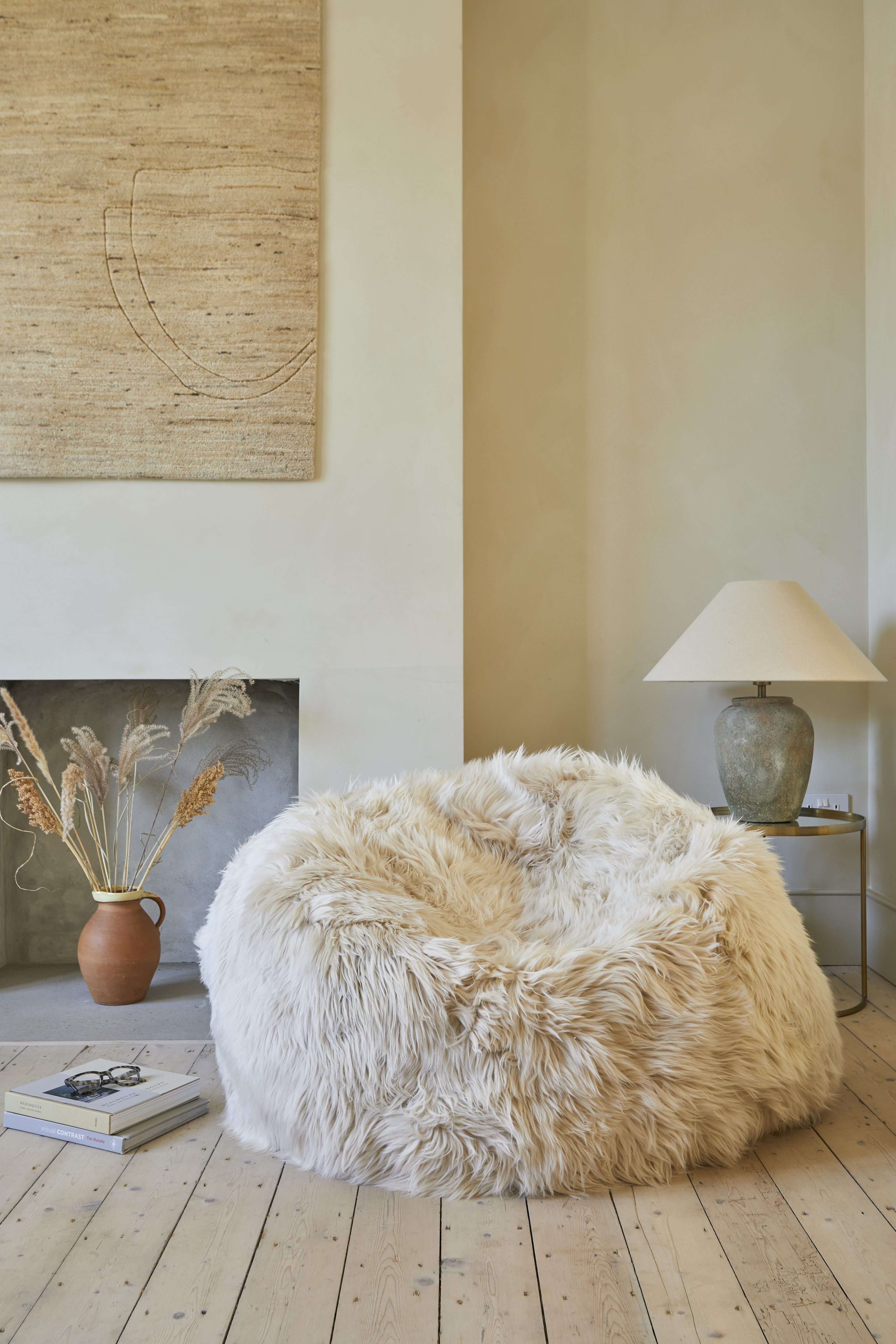
“The most photographed chair in London”

Arabella:
“I made the wonderful Amy Somerville search and search again and promise that it was sheep wool.  It is!  It is a long haired Mongolian sheep.  It must be the most photographed chair in London in the past seven days.”

Giles:
“Lets talk about the exciting possibilities that pattern on the floor presents-”

Cristian Zuzunaga’s exclusive contribution to Wool House

Arabella:
“The one thing that Bridgette has rammed down my throat from the beginning was that we had to include carpet in Wool House and it couldn’t be boring beige carpet.  We needed something that really represented the choice of colour available in carpets and I had the idea of having a pixelated pantone of colour.  There was a lot of scratching of heads and finally I took this idea to the fabulous Spanish designer Cristian Zuzunaga.”

Arabella:
“Wool is the new linen, it’s the new cotton and the new silk.”

We hope you enjoyed this excerpt from the Meet The Designers session, if you weren’t lucky enough to attend the event.  If you’d like to find out more about any of the talented individuals involved in the above event, check out the designers section on our main site, or visit any of the links below:

Arabella McNie: http://arabellamcnie.com/

Ashley Hicks: http://www.ashleyhicks.com/

Cristian Zuzunaga: http://www.cristianzuzunaga.com/

Josephine Ryan: http://www.josephineryanantiques.co.uk/

Kit Kemp: http://www.firmdalehotels.com/firmdale-sections/newsroom-home-page/about-firmdale-hotels

Mary Fox Linton: http://www.foxlinton.co.uk/profile/mary-fox-linton

Wool House Q&A – Cristian Zuzunaga

With Wool House finally upon us, we have been weaving (ha) our way through the crowd of amazing and talented designers that have come together for this celebration of wool, in the hope of snatching a quick interview with these busy, creative people, as they showcase their craft.

To our delight, we were able to catch a few minutes with one such creative – Cristian Zuzunaga.  With a body of work spanning from print and photography, to sculpture and furniture design, we sat down for a quick yarn with Cristian about what drew him to wool.

Cristian at Wool House against a backdrop of his work

• What excites you about participating in the Wool House showcase?

To be included among such amazing Creatives and to be able to work with professionals in different disciplines  is superb as allows ones work to be seen in the right perspective and generates the right situations for future projects. The show is very well organized, coherent, present and very inspiring– Arabella McNie has done a FANTASTIC job without losing her positivity.  She always has a positive energy – it is so rare to find individuals like her.

• What properties of wool do you find most valuable in your work?

Its versatility and endless possibilities allow creativity to flow in an unexpected way.  You are always surprised of its texture, feeling, vibrancy and colour acceptance.

On top of that wool is a unique natural material that is sustainable per se, and it really has played a role in allowing culture (as we know it) to emerge and florish.

• What would be your dream project to work on?

I am living it right now! I like the unexpectedness that is generated through my work, attracting all kinds of people and situations.

To find out more about Cristian’s work and to stay up to date with his latest activities, you can head over to his website here and join his group on facebook.  Don’t forget, it isn’t too late to head down to Wool House and see Cristian’s work for yourself – entry is free!  Check out our Events Calendar to find out what’s on!

Wool House Q&A – Donna Wilson

During the hectic behind the scenes run up to the Wool House event, Somerset House was packed with the talented artists and designers who have come together to celebrate wool in this amazing showcase. We were absolutely thrilled to get a few minutes with the fabulous and creative Donna Wilson to talk about all things Wool House.

Donna amongst her many wonderful creations.
Pciture taken from www.donnawilson.com


• You have a broad portfolio, from furniture and furnishings to cuddly toys. What has been your favourite project to work on?

“That’s a difficult one, as I think I enjoy the diversity of projects we have done, and the favourite part of the job for me is designing something new.  Seeing something put into production for the first time still gives me a lot of satisfaction. “

“But if I had to choose, the book Creative Creatures – a childrens’ activity book.  It was really fun to work on as I had to make mini sets for the backgrounds of the activity – I wanted the book to have a ‘real’ feel to it, not just images photoshopped together.  I had creative freedom too which is great.”

Mr. Charles Von Snugglesworth by Courtney from Brookyln, created as part of Donna’s Monsters and Magpies project.
donnawilsonltd.tumblr.com

• What was the inspiration behind your Monsters and Magpies project on tumblr?

“We thought it was nice to for people to show off their creations on the tumblr site, or get ideas before they start on one! The Make Your Own Monster and Magpie kits were originally designed to use up scraps – I’m a compulsive hoarder and can’t bear to waste anything! We had accumulated lots of scraps of the lovely knitted lambswool we use to make our creatures out of.  I always remembered as a child making things out of any old bit of fabric or felt lying around, so we got some felt bits cut especially for the kits.  The main ingredient for them is imagination, though.   I didn’t want any rules for the kits, just to encourage the maker to be as original unique and imaginative as possible.”

• What excites you about participating in the Wool House showcase?

“The Wool House showcase is really exciting as it brings together lots of beautiful products which are made using my favourite fibre – wool! I’ve always used wool a lot, as it’s a lovely natural material, and you can dye, felt knit, weave it (and more); there’s so much you can do with it. I’m not sure where my love for wool came from, but it might be something to do with growing up on a farm – I had a pet sheep called black sheep! At college I used to make and sell felt pictures, and loved the colours you get.”

“I have also loved doing the nursery room, as I have just had a baby myself, so I’ve tried to make it my dream nursery – if I had that sort of space!”

• What properties of wool do you find most valuable in your work?

“The felting.  I normally wash and felt up my knitting which gives it a lovely finish.”

• What would be your dream project to work on?

“I’d love to do an animation where I get all my creatures moving, and showing off their unique personalities!”

• Finally, do you have any advice for young artists out there?

“Work hard, be original and stick to your principles – I never wanted to be like anyone else, and I think one hardest but most satisfying things is to come up with your own style and language, and separate yourself from everyone else. I also wanted to keep all my production done within the UK, and so far we’ve managed to do that, so I feel like I’m supporting our own economy, in the tiniest way!”

If you want to find out more about Donna and her wonderful work, you can visit her website here.  You can also follow her on Twitter, Facebook and Pinterest to stay up to date on all her latest activities.  She also keeps a blog which is well worth a look, and her aforementioned Monsters and Magpies tumblr account.

If you haven’t made it down to Wool House yet, what are you waiting for?  The showcase will be running until the 24th of March and entry is free.  Each day is packed with activities, so why not come along and join the world’s biggest celebration of wool?  Take a look at the Events Calendar to see what’s coming up!

Wool House Q&A – Shauna Richardson

In the run up to the Wool House celebrations, we’ve had the opportunity to get together with some of the talented artists and designers participating in the event.  We were thrilled to be able to get a few minutes with the fantastic Shauna Richardson for a quick chat about all things Wool House.

Shauna showcasing her Trophy Bull Head crochetdermy piece.
Pic taken from www.shaunarichardson.com/crochetdermy

· Like the Lionheart project before it, Crochetdermy Brown Bear is another large scale piece. What motivates you to create such grand installations?

“Big challenges are what keep me motivated.  In fact the brown bear was the first piece of Crochetdermy I ever created, a pretty ambitious piece to cut my teeth on.”

· What properties of wool do you find most valuable in your work?

“I find wool the perfect sculptural medium, ideal for 3D work.  Realism is something I like to play with and wool yields the desired result.  I would like to list the exclusive use of a British product as one of the most valuable aspects in my work, I have been on a quest for some time now to find somebody in this country to produce something similar to chunky brushed mohair  sadly to no avail. Yet.”

· What excites you about participating in the Wool House showcase?

“Somerset House is a great setting and the show looks really exciting. The bear is in splendid company, I’m very happy to have been chosen to take part. I’m looking forward to seeing the exhibition come together and meeting the interesting people who will undoubtedly be there.”

 
Shauna is flanked by the colossal Lionheart Project sculptures.
Pic taken from: http://www.lovecrafts.co.uk/lovecrafts-blog/2012/05/18/three-lions-on-display/

· Your schedule must vary between intense bouts of crafting and touring with the finished piece.  Which do you find more enjoyable, the actual act of creating a piece of art, or showcasing it to an audience?

“Apart from the Lionheart Project which was a massive leap into the world of touring, I tend not to tour my life-size pieces. Although introducing the work to audiences is a delight, I am most content when creating. The undertaking is time consuming, happily that suits me very well.”

· What would be your ‘dream’ project?

“There are so many. Since the early days I have wanted to create a museum style installation of albino animals. An invitation to do that along with the necessary funding would be splendid.”

· Finally, do you have any advice for young artists out there?

“Being an artist is is the best, making a living as an artist can be tough. Certain maverick tendencies come with the territory, and I am sure that creatives will create what and however they want, regardless of any advice.”

If you want to know more about Shauna’s previous works, you can check out her website here.  You might also want to read our previous Q&A with Shauna on her incredible Lionheart Project, which can be found here.

If reading this has given you an appetite for the world of wool, it isn’t too late to get yourself over to Somerset House and join in the Wool House celebrations.  Entry is free and there are a host of events, demonstrations and showcases to commemorate the world’s largest celebration of Wool.  Check out our Events Calendar to see what’s on and come and join us at Wool House!

Wool House Q&A – Jason Collingwood

In the hectic run up to Wool House, we have descended into the hustle and bustle to have a quick chat with some of the incredibly talented and creative people involved in the world’s biggest showcase of wool.  We were able to snatch this very brief interview with rug weaving maestro, Mr Jason Collingwood.  Jason describes himself on his brilliant Twitter feed as “notoriously antisocial and reclusive”, though we found him perfectly charming! Check out his interview below.

 
The face that weaved a thousand rugs – a rare snap of the reclusive Mr Rug himself
https://twitter.com/mr_rugweaver

 • How did you get involved in the rug making profession?

“Truth be known it was because I didn’t know what else to do at the time and thought I’d give it a go for one year, that was 27 years ago!”

 • You divide your time between weaving rugs and teaching rug weaving techniques in classes.  Which do you enjoy more, creating new works or sharing your craft with others?

“Both balance each other out well. The solitary life of weaving juxtaposes well with the frenetic life of being on the road teaching.”


An awful lot of wool goes into weaving a rug.  Just ask Jason Collingwood…
Pic from Jason’s twitter feed

• What properties of wool do you find most valuable in your work?

“For me as a rug weaver, it’s durability and ‘warmth’.”

• What excites you about participating in the Wool House showcase?

“I’m looking forward to getting people to have the ‘connect’ with wool and a finished product, to see the process.”

You can take a look at Jason’s website here.  Because we were pushed for time, we weren’t able to go into detail about the weaving process but if you’re interested to know more, you can check out his FAQ.  His Twitter is also well worth a read –  follow @mr_rugweaver now!

If you haven’t been down to Wool House yet, it isn’t too late!  Entry is free and there is a host of incredible talent and amazing craft being showcased at Somerset House until the 24th March.  Check out the Events Calendar to see what’s on and get yourself down to Wool House!

Wool House Q&A – Ashley Hicks

In celebration of the Wool House showcase, we caught up with the immensely talented author, furniture designer and interior designer Ashley Hicks to talk about all things wool -

Ashley Hicks answers our questions about Wool House below…
Pic taken from: www.ashleyhicks.com

· What excites you about participating in the Wool House showcase?

“Of course I love wool, and it has been great fun to put together a room using no other fabrics, but the thrill of doing something inside London’s finest public building is tremendous.  My scheme for the Study was inspired by an imaginary client, one of those classic English gents of the civil service who worked in these rooms for so many years.  Walls of sober, pin-checked grey flannel like their business suits, with sudden flashes of bright pinks and reds like their braces, socks and handkerchiefs, suggesting some hidden flamboyance.  He has left the room for a moment, leaving William Chambers’ drawings for Somerset House on his red lacquered desk. His Grayson Perry prints and trompe l’oeil Collectors Cabinet are topped by gilded flames to show a certain imagination, his ‘thing’ for obelisks to show a craving for the monumental…”


Ashley was kind enough to provide a sketch of his upcoming Wool House showcase.

· What would be your dream project to work on?

 ”Honestly, this was pretty good! An imaginary client is not going to object to anything and needs no persuasion – and Somerset House! Plus our wonderful friends at all the suppliers have produced all these marvellous fabrics with immense speed and perfect quality.  Alternative Flooring especially came through with my new Chainmail design carpet woven in record time.  I got to do what I really love which is to make bits myself, like the carved & gilded mirror (gilded by my assistant John Weiland but carved – badly! – by me), the pop–coloured sculptures and painted screens.”

 · What properties of wool do you find most valuable in your work?

“As a child I’d go say Good Morning to my father as he lay in his bath, dramatically placed in the centre of his atmospheric, cosy bathroom stuffed with Victoriana.  The floor was covered in his own first geometric carpet, woven the year I was born.  All wool, of course: Brussels weave, as fitted in smart English rooms since 1760.  I still use the same Yorkshire mill for custom projects. Wool is warm, hard-wearing, comfortable – we all know that. As in my Study, you can print on different wools and get depth and texture unlike anything else.  For my old London home I made a sofa covered in short-clipped sheepskin which was the most comfortable thing I’ve ever known, warm in winter, cool in summer and unbelievably soft.  I’d just sit there, stroking it.”


If you want to learn more about Ashley Hicks, where better to start than his website, which can be found here?

Head down to join us at Somerset House and see the Study yourself.  Entry to Wool House is free and each day is brimming with activities and events to celebrate this incredible textile.  View the Events Calendar here and come along!

Wool House Q&A – Josephine Ryan

With Wool House in full flow, we were lucky enough to get together for an interview with antiques dealer-cum-interior designer Josephine Ryan to talk about all things Wool House.

Read on to find out what Josephine had to say about her part in the Wool House celebrations
Pic from: http://josephineryanantiques.co.uk/

• What excites you about participating in the Wool House showcase?

“I am totally enraptured with this project.  This show is enthralling, has totally captivated my imagination & fired up my creativity.   Sheep are supposed to help you sleep (at least the counting of!) but the blasted little creatures are keeping me awake as I can’t think about anything other than this show at the moment!  So much so, I have been neglecting my business & driving everyone at home wooly!”

“If truth be told, I am always like this when I get involved with a project.  Who could not be grabbed by what the wool campaign is about? – it’s safeguarding the future of sheep farming and promoting the wool industry.  I particularly love the global aspect of the campaign.  “Rustic” is my middle name, so going out to find woollen rugs and blankets has been an absolute joy.  I have also loved discovering the who’s who of all things wool – the talented designers and artists who have contributed to this exhibition.  Being able to work in the magnificence of Somerset House is also something any designer would die for! And I love working on a project that is not (directly) about selling as it allows one to be truly creative & innovative.”

“Simply put, I am thrilled, delighted & very very flattered to have been invited to participate.”


Josephine’s work strongly favours the rustic and the antique aesthetic
Pic from: http://josephineryanantiques.co.uk/


• What properties of wool do you find most valuable in your work?

“There is a piece in the current House & Garden magazine about Wool House where Arabella McNie, the curator of this show, states that I normally only work with linen.  She’s right! In general, I am always drawn to completely neutral colours and natural fabrics. Linen has always been my fabric of choice, although I have chosen wool in the past to upholster chairs.  I don’t use many carpets in my interiors, but in designing this room, I have thoroughly enjoyed using wool in many different guises – on the walls, floors and shelves. It has certainly inspired me to use it as much as its poor relation, linen, in my future work.”

“The star pieces in my room, a large pair of c19th English ‘Howard’ armchairs have been given a unique make over being covered in a patchwork of old aran jumpers.”

• What would be your dream project to work on?

“Now there’s a question! “

As I’ve said this has been an amazing project & I hope hundreds of people will visit. It will all be pulled down in only 12 days so if just one person walks through my space & is captivated by what they see & has the vision & trust to allow me, carte blanche, to create a whole home for them that would be one dream fulfilled.  “

“I’d love for my new shop in Langton Street in Chelsea to become a great success, and to be as well known & patronised as the likes of The Conran Shop which I admire hugely.”

If you want to find out more about Josephine Ryan and her work, you can visit her website here.

There is still plenty of time to come down to Wool House! Entry is free and each day is packed with things to see and do.  Take a look and see what events are on by visiting our Events Calendar and head down to Somerset House and join us in celebration of all things Wool!

International Woolmark Prize 2013 Round Up

We’ve been very excited about this year’s Woolmark Prize, and it was great to see all the designers’ hard work come to fruition. Congratulations Christian for a well earned win!

At a star studded event at the new ME London Hotel , top honours went to Belgian designer Christian Wijnants, for his fashionable, wearable collection of merino wool garments. Christian’s chunky, brightly coloured wool dresses – some incorporating Spring’s hottest hue, yellow – blew the judges away. Crafted from 100% merino wool, his stunning wool dress collection will be available in luxury boutiques including Harvey Nichols, David Jones and Bergdorf Goodman.

woolmark-judges

Woolmark Prize 2013 Judges (Left to right): Donatella Versace, Diane Von Furstenburg, Franca Sozzani, Victoria Beckham

Franca Sozzani, Editor-in-chief of Vogue Italia and L’Uomo Vogue, who was one of the judges, commented, “Christian invented a new shape and made it possible with an industrial production process. His designs are flattering, feminine and sexy, a modern interpretation of wool.”

Victoria Beckham commented saying, “What I think is really great about Christian (the winner) is that technically he is really good and there is a strong fashion message there. But it is also very wearable. I think it could really sell. He ticked all of the boxes we were looking for, he really did.”

Inspirations for the large gauge knits including the colours of minerals and crystals, and a desire to create an utterly seamless garment.

Dion Lee

Dion-Lee-Woolmark-Prize

Australian finalist Dion Lee

This exquisite Dion Lee dress was Australia’s entry into the International Woolmark Prize.The sculptural lines of his nominated collection were complemented by shibori style dyes and an attention to detail that included precise, rib cage style slashed wool fabric, origami folded skirts, sharp blazers and knits that faded from opaque to sheer. He was inspired by Sydney Opera House, the iconic  Australian akubra hat and millinery in general. He’s been pegged as one to watch, and being nominated for the Woolmark Prize bears that out. We particularly like the way he has combined several wool techniques – including unspun wool roving, needle felted mesh and knitting – highlighting the versatility and practicality of wool.

Sophie Theallet

Sophie

US Finalist Sophie Theallet

Sophie Theallet‘s chic, timeless style aims for a sophisticated yet practical vibe. Her feminine interpretation of sheeps wool apparel has led her to create a mature and enduring range of dresses – her work has been compared to fashion luminary (and Woolmark Prize judge)  Diane Von Furstenberg. The result was a collection of incredible knitwear, woven wool sheath dresses and a natural colour palette interspersed with pops of bright red and coral, perfect for Spring. We particularly like her use of strong colour, showcasing that wool can be a vibrant and colourfast dye medium.

Pankaj and Nidhi

Pankaj and Nidhi

Pankaj, of Pankaj and Nidhi, shows judges one of their garments.

The fashionable Indian design duo have created wool clothing referencing the bright colours and intricate embroidery of their homeland, accented by ‘merino wool fur’; a signature material they use and are trying to promote as an ecologically friendly version of animal fur. They have also explored Polish techniques, and used over stitching to personalise Indian fabrics, which they lament are too uniform, with mills refusing to create short runs of customised woollen fabric.

Ban Xiao Xue

Chinese-Finalist

Ban Xiao Xue

The Chinese finalist cites nature as his true inspiration, and has spoken eloquently about the properties of wool as a material, praising it’s natural breathability, warmth and versatility. He chose to let the fabric drape naturally for the most part, wanting to preserve the sense of the organic by cutting as little as possible.

DressedUndressed

DressedUndressed

Japanese Finalists DressedUndressed

The Japanese duo’s minimalist, monochromatic aesthetic combined biker zips, traditional Japanese silhouettes and sharp tailoring. Their androgynous fashion collection was also crafted entirely from merino wool, a renewable, biodegradable resource.

Well, we’ve explored the 2013 Woolmark Prize and had a look at each of the talented contestants. It looks like Autumn / Winter 2013 will be characterised by tailoring, intricate dye patterns and a warm colour palette centering on red, pink and cobalt. Craftsmanship is enjoying a renaissance and the orient is still popular – as seen here in the Samurai style topknots of the models, the origami folding used by Dion Lee (complimented by shibori style dye techniques) and the kimono – lite hint from DressedUndressed’s uncompromising androgyny. All in all a fantastic Woolmark Prize, and we can’t wait for the next one!
CC – Pictures from Woolmark Prize Facebook Page


A Q&A with Tom of Holland

Continuing with our “Make Do and Mend” theme this month, we sat down with the incredible and talented Tom van Deijnen, AKA Tom of Holland, to discuss the joys of wool, Visible Mending, and the history of a garment.  Read on for the interview…


Tom celebrates Wovember

• We know that you prefer to work with wool.  What is it that makes wool so special for you?

 Having grown up with grandparents who had a farm, with amongst others, sheep, my love for wool has always been there. Also, my mum used to knit a lot, and she always let me choose the wool for my jumpers. It’s only later, when I first learnt more about wool, and got involved with Wovember, that I started to realise what a truly amazing fibre it is. It is so diverse, and now that I’m more aware of the specific qualities of breed-specific fibres, I feel even more inspired by it; there’s a lot of exploring to do. From supersoft merino to coarse Herdwick, they all have something special to offer.

• Tell us a little about Wovember.  How did you get involved?

Wovember was an initiative set up in November 2011 by Kate Davies and Felicity Ford. They were not happy about the lack of clear labelling and descriptions of garments, which were often portrayed as made from wool, but often not containing any wool at all. Through Wovember they hope to create a force for wool appreciation strong enough to effect changes in how garments and textiles are described and marketed. Felicity asked for a contribution, and I wrote a post about the etymology of the words “sheep” and “wool” in English and Dutch, as there are many links. Then last year I joined the team and we had a lot of fun running Wovember 2012. We have been lucky to get contributions from people in the wool world from many quarters – I still feel inspired!


Wear your repairs with pride!

• You’re something of a darning guru.  What is it that draws you to repairing old garments over creating new ones?

Actually, I like both creating new garments as well as repairing them. Latterly, I’ve started to see this as a continuum. I’m an avid knitter, and once I’ve cast off something, then that is not the end of it. For me, a garment is never really finished, as I anticipate the repairs and alterations to come. I sometimes can’t wait for a hole to appear, as I already have some repair or darning ideas. I like my repairs “out and proud” and celebrate visible mends, which is why I set up the Visible Mending Programme.


With visible repairs, you can trace the history or a gament

• Your Visible Mending Programme is a great idea!  How did this idea come about?  Tell us a little bit about the programme…

I have always made minor repairs or embellishments to garments that had developed a hole or a stain. But I realised through hand-knitting that I cared more about my hand-knitted socks and jumpers, then about shop-bought clothes. Looking at a knitted garment, I can trace back where and when I made it. With The Visible Mending Programme I try to promote the same connection; when darning, you can think about when and where the garment was acquired, what occasions it was worn, and the motivation of the repair. A visible mend records and shows the history of a garment, with the darn worn as a badge of honour. By writing a blog, taking commissions and running workshops I can offer mending inspiration, services and skills to the world.


The Curiosity Cabinet of Knitting Stitches – coming February 15th

• What future exhibitions do you have coming up?  Is there anything you can tell us?  Any exclusives?

Spring is a busy time for me this year: on 15 February my new exhibition at Prick Your Finger opens: The Curiosity Cabinet of Knitting Stitches. This comprises two display cabinets of knitted swatches, exploring a large variety of techniques old and new, well-known and obscure, displayed as if they were part of a Natural History Museum collection.


Tom shares his wisdom at one of his regular darning classes

I also have a number of darning classes and workshops coming up: my regular darning class at Super+SuperHQ in Brighton at the start of February. I’ll be running a drop-in darning class during the Wool House exhibition in Somerset House. And in May I will be running darning and mending day workshops at Hope & Elvis in Wolsop, Nottinghamshire, and The Stitchery in Glasgow.

 In between all this I’m planning to explore darning samplers, using woollen fabrics, patches and mending yarns.

• Finally, do you have any tips you can share with our readers?  Any tips for seasoned darners or tricks that you wish you’d known about when starting out? 

For practical darns (e.g. on socks) match thickness of mending yarn to that of garment under repair, or slightly thinner.


Meta-darning!

If a garment is felted, then look for alternative uses. Felting cannot be undone! However, felted wool is very warm and virtually windproof, so you could turn a felted sweater into mittens, or house slippers.

When darning socks or elbows, make sure that the darned area is large enough so that it covers the thinned area around the hole. Otherwise you’ll soon develop a hole right next to the darned patch.

Although I usually make very visible darns, sometimes an invisible mend is more appropriate. That’s why I always keep my left-over knitting yarns, so I can have a perfect match. And if you don’t have any of the original yarn, then don’t get hung up on attempting to match the fibre type. Try to match colour and texture instead.

 You can check out Tom’s website and blog here - and don’t forget to follow him on Twitter!